22/10/2026
This article is written by Nick Fothergill, Andy Spicer, and Emma Woodhouse.
The draft Heat Network Zones (England) Regulations 2026 (the “Zoning Regulations”) will introduce a new heat network zoning framework in England. The zoning framework is intended to be implemented through the creation of a Heat Network Zoning Authority ("Zoning Authority") and zone coordinators (“Zone Coordinators” or “Zone Coordination Bodies”). The Zoning Authority will identify suitable areas for and keep a register of heat network zones, publish a national implementation statement (the “Heat Network Zone Implementation Statement”), and oversee the appointment and performance of local Zone Coordinators.
Appointment and oversight of Zone Coordinators
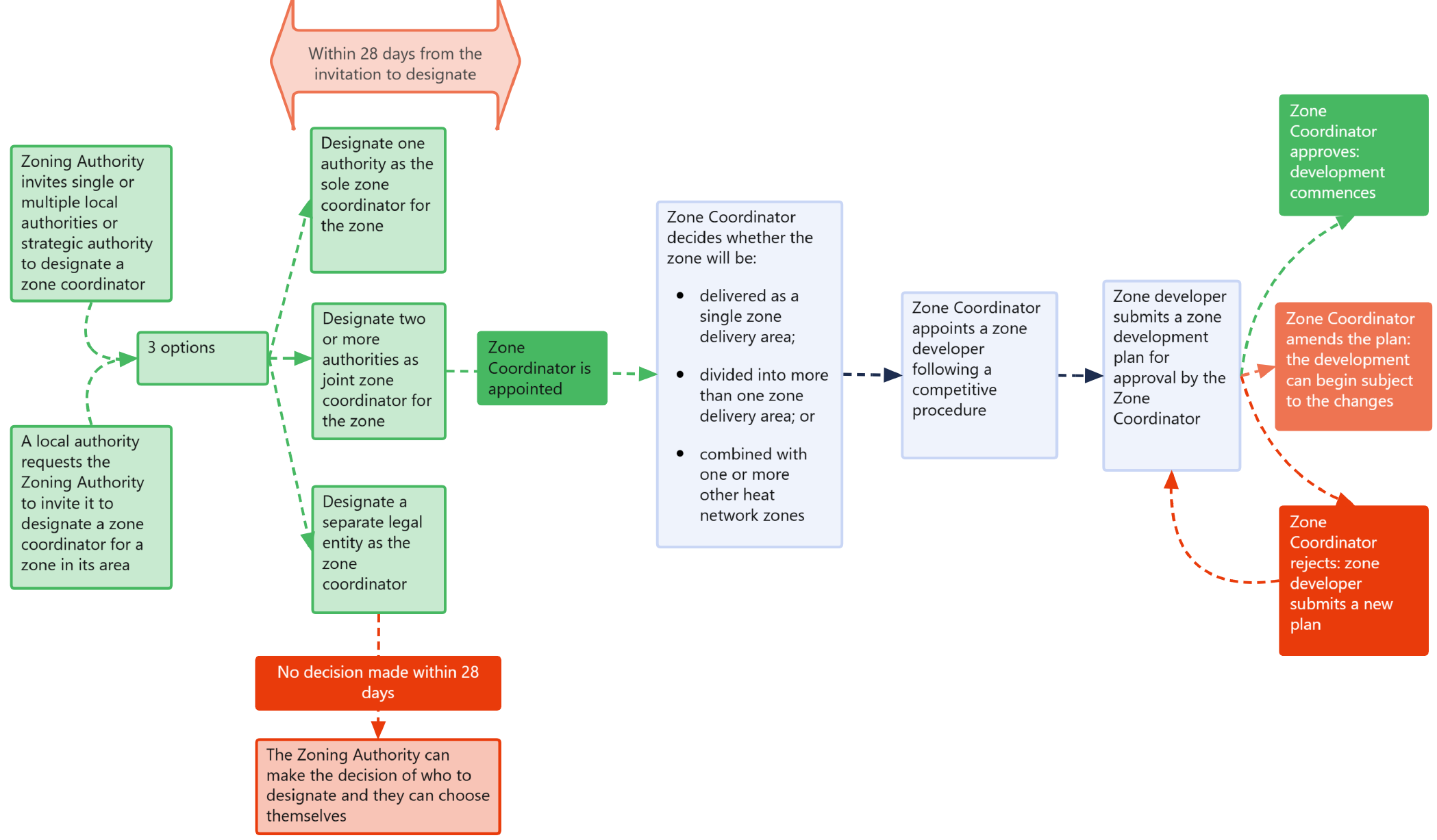
Zone Coordinators are designated under the Zoning Regulations to oversee the development and delivery of heat network zones. The appointment process can be initiated either by the Zoning Authority inviting a local authority to nominate a coordinator, or by a local authority requesting such an invitation. Local authorities may appoint a single authority, multiple authorities acting jointly, or a separate legal entity to fulfil the role. If no designation is made within 28 days (subject to extension), the Zoning Authority may appoint a coordinator itself, including appointing itself where necessary.
To be designated, a Zone Coordinator must meet certain requirements under the Zoning Regulations , including that:
The Zone Coordinator must have access to sufficient expertise to carry out its functions
Named officers will be responsible for carrying out each of the functions of the Zone Coordinator
Named persons must be contactable about each decision made by or on behalf of the Zone Coordinator
The Zone Coordinator must have effective communication, data and risk management processes in place and keep appropriate records
The Zone Coordinator must have satisfactory plans for ensuring it has sufficient resources to carry out its functions
The Zoning Authority retains significant oversight powers, including the ability to set performance indicators, issue guidance, request information, review decisions, and revoke a designation where a coordinator is not performing satisfactorily.
Functions of a Zone Coordinator
A Zone Coordinator's primary role is to plan and deliver heat network zones. Key responsibilities include:
Refining and formally designating zone boundaries
Developing and publishing a zonal market prospectus
Running competitive processes to appoint zone developers for each zone delivery area
Coordinating zone delivery and operation of the zone
Promoting the supply of thermal energy using district heat networks
Zone Coordinators also have extensive information-gathering powers and may require relevant data from building owners, heat network developers and operators and other stakeholders, and they must also publish progress reports annually.
Under the Zoning Regulations, the Zone Coordinators will have additional powers over other types of district heat network, including the power to give consent to the development and/or operation of:
A campus network
A district heat network as a shared ground loop system
An existing heat network
A heat network currently under development
An alternative heat network
In addition, Regulation 34, which deals with pre-zone heat networks, also allows the Zoning Authority to appoint a Zone Coordinator and a developer and direct that an area be registered as a zone, where the heat network is in a potential heat network zone or potential zone delivery area. This is likely to be particularly applicable to current Advanced Zoning Programme (“AZP”) projects.
Governance and conflicts of interest
Each Zone Coordinator must establish a governing board led by a Chair. The board must include (unless the Zoning Authority otherwise agrees) an elected member or senior officer from each relevant local authority, and may include advisory members and individuals with specialist expertise. The board can delegate some of the decisions to individuals carrying out Zoning Coordinator functions or to a local authority. However, where the strategic decisions in Schedule 1 of the Zoning Regulations are delegated, the board must keep a register of the decision to delegate, the person to whom it was delegated, any conditions on the delegation and the date of the delegation.
The Zone Coordinator can set up a separate legal entity to carry out its functions as long as the Zone Coordinator controls the entity, meaning they must hold a majority of voting rights or have the power to appoint and remove a majority of board directors or other governing body of the entity.
The Zoning Regulations place significant emphasis on managing conflicts of interest. Zone Coordinators must establish arrangements for identifying and managing actual or potential conflicts, to ensure that they do not, and do not appear to, affect the integrity of the Zone Coordinator’s decision making processes.
Appointment of Zone Developers
Following registration of a heat network zone, the Zone Coordinator must determine the most effective delivery structure, including whether the zone should operate as a single delivery area, be divided into multiple delivery areas, or be combined with neighbouring zones.
Zone developers are then appointed through a competitive process and must satisfy a "fitness to operate" test, including requirements relating to financial capacity and technical expertise. Each developer must submit a zone development plan for approval by the Zone Coordinator before construction can commence. The Zone Coordinator has the power to approve, reject or require amendments to the development plan.
Structuring a Zone Coordination Body
A key decision for local authorities is how the Zone Coordinator (or Zone Coordination Body) should be structured. Two principal considerations arise:
Whether the body should be operated by a single authority or multiple authorities
Whether it should be incorporated as a separate legal entity or remain unincorporated within the local authority structure
Single-authority vs multi-authority models
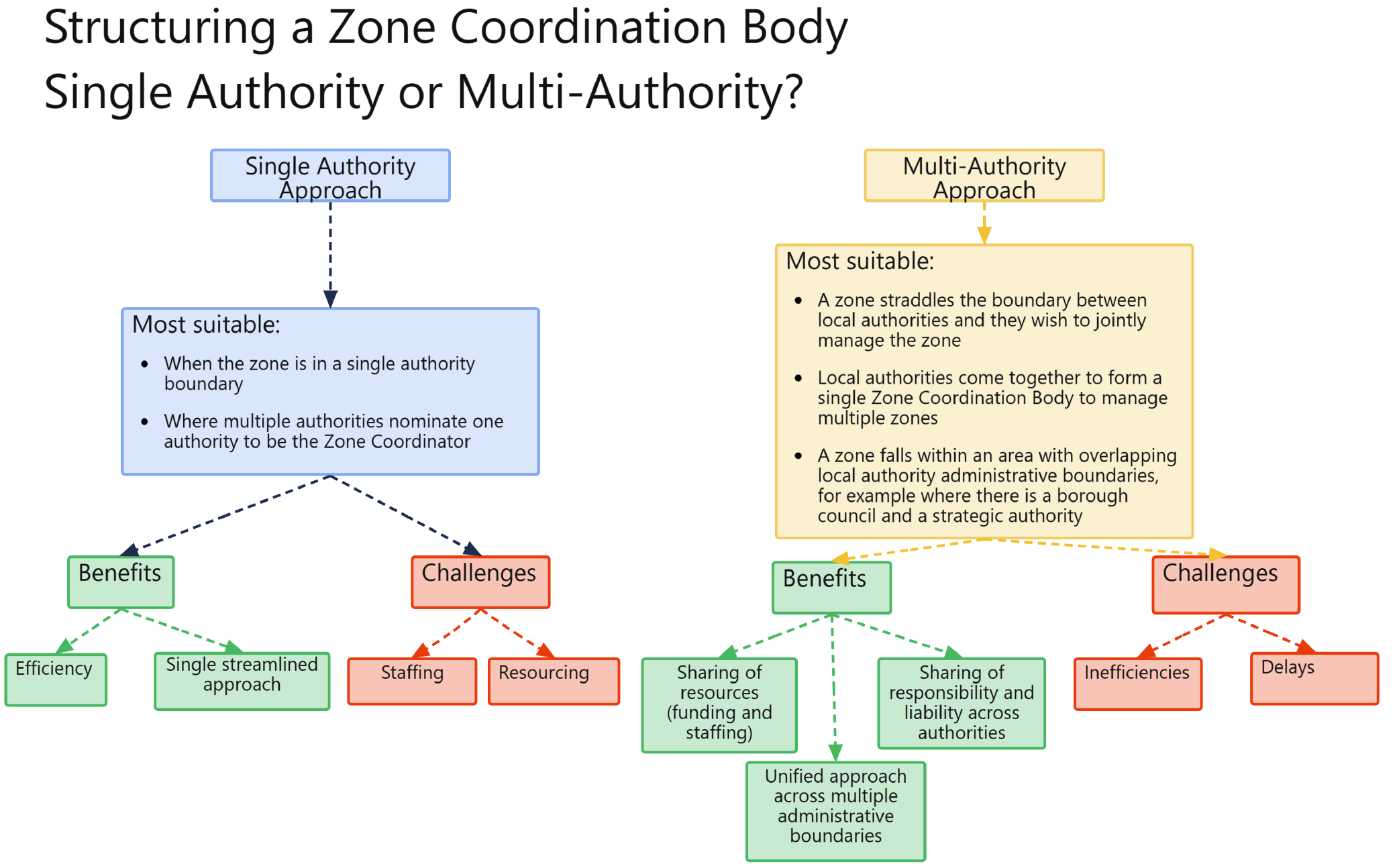
A single-authority model is generally suitable where a zone lies within one local authority area or where multiple authorities nominate one authority as Zone Coordinator. A single-authority approach benefits from simpler governance and decision-making, and potentially greater efficiency. However, staffing and resourcing challenges may arise.
A multi-authority model may be preferable where zones cross administrative boundaries or where authorities wish to share resources and responsibilities. While this can promote consistency across wider geographical areas and sharing of resources and liability, it may also introduce additional complexity and slower decision-making.
Once local authorities have determined whether a single authority or multi-authority approach is more appropriate, they must decide on the governance structure for the Zone Coordination Body. DESNZ has identified several governance options, including:
Single-party
Consortium
Two-tier multi-party
Fully joint multi-party arrangements
The different structures allow authorities flexibility to adopt governance arrangements that reflect local circumstances.
Incorporated vs unincorporated structures
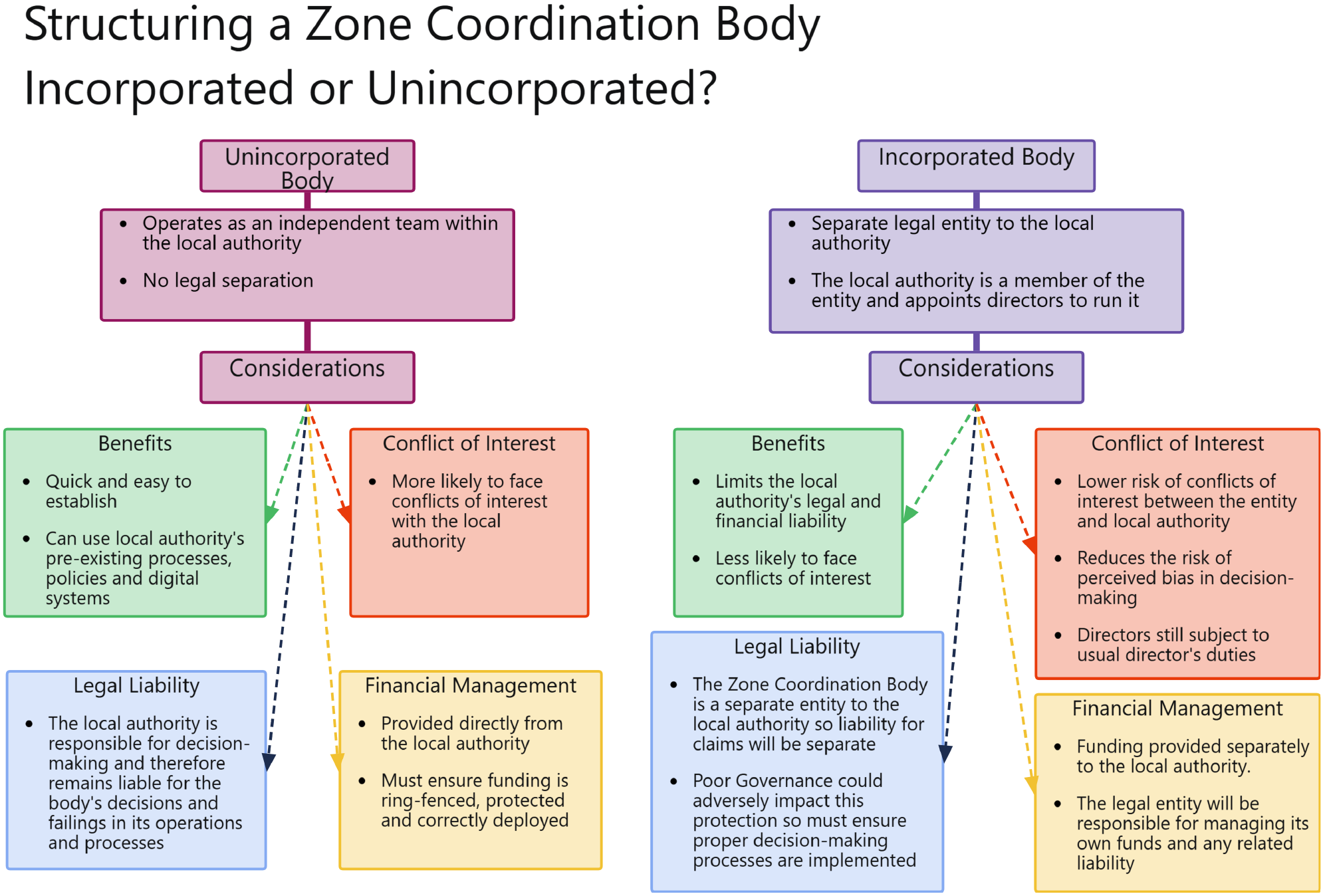
An unincorporated Zone Coordination Body operates as an independent team within the local authority and can benefit from the authority’s existing systems, processes and staffing arrangements. However, the authority remains directly liable for the body's decisions and the Zone Coordination Body may face greater risks of conflicts of interest.
By contrast, an incorporated Zone Coordination Body is a separate legal entity with the local authority as a member of the entity and can appoint directors to run it. This model can provide greater operational independence, reduce conflict-of-interest concerns and limit liability exposure for participating authorities, provided that robust governance arrangements are maintained. Another benefit is that the incorporated entity is responsible for managing its own funding and liabilities.
When determining the most appropriate structure, authorities should focus on three key issues: legal liability, financial management and conflict-of-interest risk. Factors such as local authorities having ownership interests in heat network assets, financial interests affected by zoning decisions, or overlapping governance arrangements may make a more independent incorporated structure attractive.
Conclusion
The proposed zoning regime places Zone Coordinators at the centre of heat network planning and delivery. While local authorities are given flexibility in how they structure and govern these bodies, the Zoning Regulations impose robust requirements around accountability, performance, governance and conflicts of interest. Careful consideration of governance arrangements, particularly the choice between incorporated and unincorporated models, will be essential to ensure effective and independent delivery of heat network zones.
Stay current — follow our dedicated Energy & Resource Management page today.